Batik Indonesia 2011 Sejarah Baik Indonesia - Batik dari Indonesia kini semakin populer dan makin berkibar di dunia. Bagaimana perkembangan batik indonesia untuk tahun 2011 ini? Adalah KJRI Hamburg sudah mempromosikan batik dari Indonesia di negara Jerman. Dan kabar baiknya banyak sekali orang dari Jerman menyukai batik dari Indonesia.
Sejarah Batik Indonesia
Sejarah adanya batik di Indonesia memang sudah sangat lama, Dan berbicara sejarah Batik di Indonesia, batik Indonesia berasal sejak dari zaman nenek moyang kita yaitu sejak pada abad XVII. Kala itu batik ditulis dan dilukis pada sehelai daun lontar. Dan pada waktu itu pemilihan motif atau pola batik masih sebatas pada motif bentuk Binatang serta motif Tanaman. Dan seiring dengan perkembangan sejarah batik di Indonesia lambat laun batik mengalami perkembangan. Yang mula-mula hanya bermotif corak-corak seperti lukisan binatang dan lukisan tanaman lambat laun bergeser pada motif yang sifatnya abstrak seperti motif awan, relief candi, wayang beber dll. Pada sejarah perkembangan batik Indonesia selanjutnya mulai ada penggabungan motif corak lukisan dengan seni dekorasi Pakaian, hingga muncul beragam Seni batik tulis seperti ada sekarang.
Batik sebagai salah satu warisan Budaya Indonesia makin mendapat tempat masyarakat dunia. Dari KJRI Hamburg Jerman pada hari Kamis tanggal 23 Juni 2011 telah menyelenggarakan sebuah acara untuk pengenalan dan demo untuk batik Indonesia dengan acara tema "The Beauty of Batik: An Indonesian Heritage". Acara ini diselenggarakan di Wisma Konjen RI Hamburg, Jerman.
Pada acara pengenalan dan demo batik tersebut telah dihadiri sebanyak 25 tamu undangan antara lain yang berasal dari Konjen AS, India, Yunani, Venezuela, China, Mesir, serta para spouse yang berasal dari beberapa kepala perwakilan asing yang ada di Hamburg yang telah tergabung dalam Consular Women Club, Dir. Hublu Kadun Hamburg, pengusaha, dan sejumlah media internasional.
Pada acara tersebut Konjen RI Hamburg M. Estella Anwar Bey memberikan sambutan bahwa tujuan diselenggarakannya acara tersebut adalah untuk memperkenalkan dan meningkatkan tentang pengetahuan untuk para tamu undangan yang hadir mengenai batik. Batik adalah salah satu produk tekstil asli yang berasal dari Indonesia yang cara pembuatannya memakai sentuhan budaya tradisional indonesia .
"Batik Indonesia yang berasal dari beberapa daerah yang ada di Indonesia dapat dikenal melalui warna dan coraknya. Pada setiap corak yang terdapat pada kain batik dari daerah Indonesia memiliki arti yang berbeda. Sekarang ini batik Indonesia telah ditetapkan oleh UNESCO sebagai salah satu Warisan Budaya Dunia Dari Indonesia ," tuturnya.
Pada acara promosi dan demo batik yang di selenggarakan di Hamburg Jerman tersebut dikemas dalam waktu 2 jam. Acara tersebut dipandu oleh Frau Annegret Haake, beliau adalah seorang pakar yang mengerti batik dan berkebangsaan Jerman. Sudah sejak tahun 1970 Frau Annegret Haake telah menekuni dan mempelajari batik Indonesia dan menulis beberapa buku mengenai batik Indonesia diantaranya adalah "Javanische Batik : Methode – Symbolik - Geschichte".
Dalam acara tersebut terbagi dalam tiga sesi acara, diantaranya adalah pemutaran film mengenai produksi batik Indonesia yang berjudul "Indonesian Batik : A Living Art, Local Tradition and National Pride", kemudian presentasi mengenai penjelasan dan sejarah batik di Indonesia, jenis dan corak batik, serta praktek bagaimana cara pembuatan batik dengan menggunakan teknik canting dan cara pencelupan kain dengan pemakaian bahan malam sebagai bahan untuk menahan bahan pewarna di kain.
Showing posts with label * Batik. Show all posts
Showing posts with label * Batik. Show all posts
Saturday, August 20, 2011

Sunday, August 14, 2011
Introducing of Batik



Etymology
The word "batik" is derived from the combination of two words in Javanese: "amba", meaning "write" and "titik" which means "point".
History of batik technique
Batik textiles from Niya (Tarim Basin), China
Detail carving of cloth worn Prajnaparamita, statues that come from East Java, the 13th century. Carving patterns intricate flowers are similar to traditional Javanese batik pattern now.
Art coloring coloring fabric with prevention techniques using night is one of the ancient art form. The discovery in Egypt show that this technique has been known since the 4th century BC, with the discovery mummy wrapping cloth which is also coated the night to form a pattern. In Asia, a similar technique of batik is also applied in China during the T'ang Dynasty (618-907) as well as in India and Japan during the Nara period (645-794). In Africa, such as batik technique known by the Yoruba tribe in Nigeria, as well as the Soninke and Wolof tribe in Senegal. In Indonesia, batik is believed to have existed since the time of Majapahit, and became very popular late eighteenth century or early nineteenth century. Produced batik batik is it all until the early twentieth century and the new stamp batik known after World War I or around the 1920's.
Although the word "batik" comes from the Javanese, the presence of batik in Java itself was not recorded. G.P. Rouffaer argues that the batik technique is likely introduced from India or Sri Lanka in the 6th century or the 7th. On the other hand, J.L.A. Brandes (Dutch Archaeologist) and F.A. Sutjipto (Indonesian Archaeologist) believe that the tradition of batik is a native of the area such as the Toraja, Flores, Halmahera and Papua. It should be noted that the region is not an area that is influenced by Hinduism but it is known to have ancient tradition of batik making.
G.P. Rouffaer gringsing also reported that the pattern has been known since the 12th century in Kediri, East Java. He concluded that this pattern can only be formed by using a canting, so he argues that the canting is found in Java in the period surrounding it. Detailed carvings that resemble batik cloth worn by the Prajnaparamita, the goddess of wisdom Buddhist statues from East Java century -13. Detailed patterns of clothing featuring vines and intricate flowers that are similar to traditional Javanese batik pattern that can be found now. This suggests that creating an intricate batik patterns that can only be made with a canting has been known in Java since the 13th century or even earlier.
Legend in Malay literature of the 17th century, Sulalatus Salatin told Admiral Hang Nadim ordered by Sultan Mahmud to sail to India to get 140 pieces of fabric litter with 40 kinds of flower patterns on each page. Being unable to fulfill that command, he made himself that the fabrics. But unfortunately shipwrecked on the way home and only capable of carrying four pieces that make the emperor was disappointed. By some interpreters, who? litter was interpreted as batik.
In European literature, batik technique was first described in the book History of Java (London, 1817) writings of Sir Thomas Stamford Raffles.He had been a British Governor of Java during Napoleon occupied the Netherlands. In 1873 a Dutch merchant Van Rijekevorsel give a piece of batik, which is obtained during a visit to Indonesia to the Ethnic Museum in Rotterdam and at the beginning of the 19th century batik that was started to reach its golden ages. When exhibited at the Exposition Universelle in Paris in 1900, Indonesian batik riveting public and artists.
Since the industrialization and globalization, which introduces automation techniques, new types emerged batik, known as batik and batik prints, while the traditional batik produced by the technique of handwriting using canting and night is called batik. At the same time, immigrants from Indonesia to Malaya Fellowship also carries batik with them.
Culture batik
Heroine R.A. Kartini and her husband wore batik skirt. Batik motifs used machetes Kartini is a pattern to the nobles
Batik is a craft that has high artistic value and has become part of the culture of Indonesia (especially Java) for a long time. Javanese women in the past made their skills in batik for a living, so in the past batik work is exclusively women's work until the invention of "Batik Cap" which allows the entry of men into the field. There are some exceptions to this phenomenon, namely the coastal batik masculine lines as can be seen in shades of "Mega Chance", which in some coastal areas batik work is common for men.
The tradition of batik was originally a tradition handed down, so sometimes a recognizable motif batik originated from a particular family. Some batik may indicate the status of a person. Even today, some batik motifs tadisional only used by royal families of Yogyakarta and Surakarta.
Cirebon batik motif sea creatures
Batik is an ancestral heritage of Indonesia (Java) that until now still exist.Batik is also first introduced to the world by President Suharto, who was wearing a batik at the UN Conference.
Batik is used to wrap around the body by the dancers dance in the palace Bedhoyo Ketawang Java.
Batik Variety
Batik variety of shades and colors are influenced by various foreign influences. Initially, batik has a variety of shades and colors are limited, and some patterns may only be used by certain circles. However, coastal batik absorb various external influences, such as foreign traders and also in the end, the invaders. Bright colors such as red popularized by the Chinese, who also popularized the style phoenix. European colonial nations are also taking interest in batik, and the results are the patterns that were previously unknown flowers (like tulips) and the objects brought by the colonizers (the building or horse-drawn carriage), including their favorite colors such as blue. Retain traditional batik s type, and is still used in traditional ceremonies, because usually each style has a representation of each.
How to manufacture
Batik was originally made on material with white color made of cotton cloth called. Today the batik is also made on other materials such as silk, polyester, rayon and other synthetic materials. Batik motif formed by the liquid wax by using a tool called a canting for subtle motifs, or large-sized brush for a motive, so that the liquid wax to seep into the fabric fibers.Fabrics that have been painted with wax and then dyed with the desired color, usually starting from the light colors. Immersion and then taken to another motif with color or black older. After some time the coloring process, which has dibatik cloth dipped in chemicals to dissolve the wax.
Types of batik
Batik-making
According to the technique
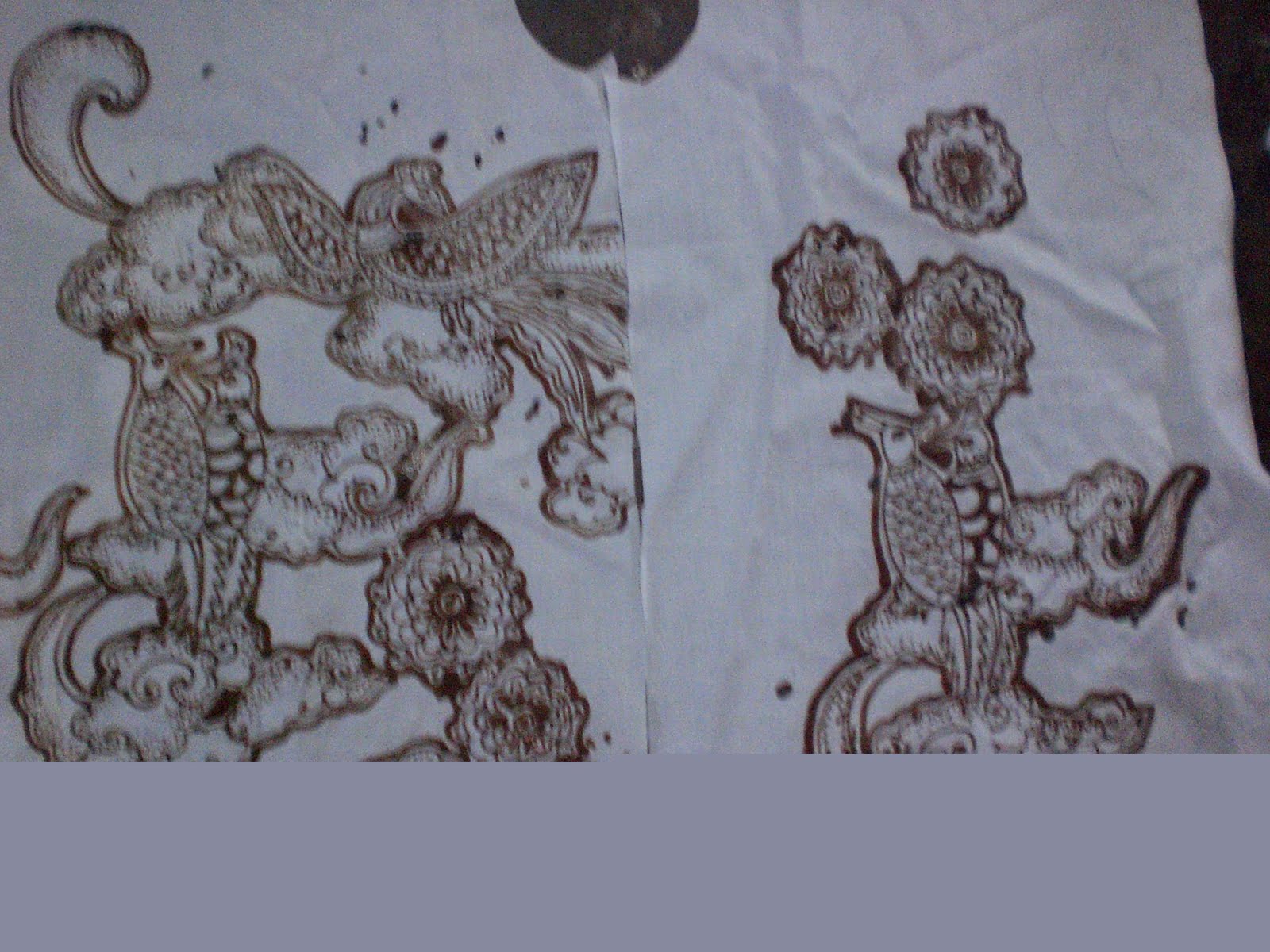
Batik is decorated with fabric textures and patterns of batik by hand. Batik making this type takes approximately 2-3 months.
Batik cap is decorated with fabric textures and patterns created with batik cap (usually made of copper). Batik-making process of this type takes approximately 2-3 days.
Batik is the process of making batik painting by painting directly on the white cloth.
According to the origin of manufacture
Javanese Batik
Javanese batik art is a cultural heritage of Indonesia, especially Java-controlled areas of hereditary Javanese. Javanese batik motifs have different. The difference is common motifs that have meaning, the purpose is not only an image but it implies that they can from their ancestors, the religion of animism, dynamism, or Hindus and Buddhists. Javanese batik developed in many areas Solo or commonly referred to as Solo batik.
Beringhardjo Market
Beringhardjo Market
 Like Sukawati Market in Bali, Yogyakarta has Beringharjo market. Beringharjo market is one of the largest traditional market in Yogyakarta and has hundreds of souvenir goods cheap and available. As you enter the market you will agree that the market Beringharjo can be called 'a small Yogya'.
The market is located in the center and easy to find because it is located in the north of the Kraton Palace, and in the around Malioboro street.. It all started with the traditional method, the bargaining process for packaging. The market is full of national and international tourists every day trying to find a unique souvenir from Yogya. You can haggle the price with the seller so do not be afraid to barter for as cheap as possible, because if you are lucky, the seller can sell goods at a price you ask.
 Beringharjo market was originally a forest of banyan trees, but after the Sultan's Palace has established a good place for business, so locals make this place a business center. The Beringharjo derives its name from the words and the Bering Harjo. Bering means 'banyan tree' and Harjo means 'required to provide the well-being'. For the people of Yogyakarta, the market has become the hub Beringharjo economic activity over hundreds of years, although now the market has turned into a pleasant shopping area for tourists.
Beringharjo market you can find various souvenirs such as kebaya, Surjan and local products, and if you enter through the west door there is a lot of batik motifs to choose from. The market has a collection of batik fabrics, from cotton and silk, are sold by hundreds to 10,000 rupiahs. Just as you can also find Keris batik that is sacred to the traditional weapon of the Javanese.
 If you're tired of walking through the market you can get away for a moment and enjoy a variety of traditional drinks that are located in the south. There is ice cendol based rice flour, and even the type of gelatin made from Cam Cau leaf. Other drinks are available iced drink fresh coconut and herbs like turmeric kencur, tamarind and rice. The drinks are not expensive and start from 1000 to 2000 rupiahs.
Beringharjo market closes at 5:00, but usually at night a food vendors selling their local food on the west side. After midnight there are usually hot sellers market in the face while eating so you can listen to music or spoken Javanese played with a seller who is always eager to chat.
Saturday, August 13, 2011
Stamp Batik Process
Manufacturing Process
- Cloth placed on a flat table that has been coated with a soft material
- Night boiled until melted and kept liquid temperatures tonight remain in kondiri 60 s / d of 70 degree Celsius
- Cap canting then inserted into the liquid the night before (about 2 cm in the bottom of a submerged fluid seal canting night)
- Canting Cap-cap later in the (in-stamp-it) with enough pressure on the cloth that had been prepared earlier
- Fluids night will soak into the pores of the cloth to penetrate to the other side surface of the cloth
- After the process of knowl-cap's done with various combinations of canting seal is used, then the cloth will do the coloring process, by dipping the cloth into the tank containing the selected color.
- Cloth whose surface has been impregnated by the liquid night, will not be exposed in this coloring process.
- After the coloring process, the next process is the removal of files motive fluid through the process penggodogan night.
- So it will appear two colors, namely the original base color of cloth that had covered the night, and the color after the coloring process earlier.
- If you will be given a combination of coloring again, eating should begin again from the knowl-stamp-an evening of fluids - coloring - penggodogan again.
- So that the necessary process repeated for each color.
- The interesting thing about batik is the process of mating colors, because the surface of the cloth who has previously diwarna will diwarna again on the subsequent dyeing process, so it needs special expertise in the selection process & wedding colors.
- Therefore the coloring process is repeated and thorough in every pore of cloth, the colors in batik tend to be more durable and long lasting compared to other batik.
- The last process of making batik is a process of cleansing and enlightenment colors with soda. Then dried and ironed.
The characteristics
- Batik color both sides of the fabric is the same
- More glossy color batik
- Motive is not too detailed
- Usually the base color is the color of old / dark
Differences written batik and stamp batik
 The development of batik in the present is quite encouraging, this positive impact on batik-batik producers in various regions. Request batik or batik is extremely high, although the market needs is already partially filled batik with batik textiles manufactured by textile companies that have capital.Some batik craftsmen wanted to pay in advance so that production can be smoothly and the buyer will receive the requested orders, it is reminiscent of the 70s which at the time that batik is also experiencing a considerable amount of demand.
Differences written batik and stamp batik can be seen from some of the following:
The extinction of batik
 It's ironic variety of batik in Indonesia is recognized as the cultural heritage of the archipelago, but it is different at madison southern sewulan precisely in the village and its surroundings.
Sewulan a fief of the kingdom of Mataram batik culture is now almost extinct swallowed up by the modernization of technology in which prices of stamp batik and printing batik is cheaper than price of written batik.
Frequently changing times currently live 5 people who work as batik and even then only as a sideline after doing the routine household activities and the age old sudan even this batik is the next generation aversereluctant because the coloring (Wedel) or immersion should be taken to Bekonang, Sukoharjo, Middle of Java or Solo. Once in there, but employers Wedel Ponorogo died and bequeathed to this son even brought to Yogyakarta Wedel practical business from 1989 until now staining process must be to Surakarta.
Three Influential Religion On Batik Art
Since the days of the Majapahit Kingdom, batik art is influenced by three religions, namely, Hinduism, Buddhism,and Islam. Most of the collection of batik Surakarta, Mangkunegaran, Yogyakarta, and Pakualaman get the influenceof these three religions.
Clothes Batik' Trend - Love of Indonesia or the emotion of a moment
 Lately, when I noticed, batik-print clothing is popular among women, especially teenagers for everyday wear. Previously, batik clothes more often used only for formal occasions. The emergence of trends such as this raises two questions in my mind: does it shape attitudes toward the work of their love of traditional Indonesia or even this form of reaction to their anger because there are neighbors who claim batik as "owned" them?
We just realized how rampant batik clothes a few weeks ago, when our mother, the dealers batik, batik clothing merchandise offered for our everyday wear. Not usually, we do not refuse. Instead, we gladly accepted it. Whether it was indeed a good model so we wanted to wear it, or whether because without us realizing batik clothes are starting to bloom among young women, so we wanted to follow the trend. However, whatever the reason, we started to wear batik clothes as everyday clothes when batik began become trend.
Friday, August 12, 2011
Introducing of Batik
 Batik (Javanese pronunciation: [ˈbateʔ]; Indonesian: [ˈbatɪʔ]; English: /ˈbætɪk/ or /bəˈtiːk/) is a cloth that traditionally uses a manual wax-resist dyeing technique. Batik or fabrics with the traditional batik patterns are found in Indonesia, Malaysia, Japan, China, Azerbaijan, India, Sri Lanka, Egypt, Nigeria, Senegal, and Singapore.
Javanese traditional batik, especially from Yogyakarta and Surakarta, has notable meanings rooted to the Javanese conceptualization of the universe. Traditional colours include indigo, dark brown, and white, which represent the three major Hindu Gods (Brahmā, Visnu, and Śiva). This is related to the fact that natural dyes are most commonly available in indigo and brown. Certain patterns can only be worn by nobility; traditionally, wider stripes or wavy lines of greater width indicated higher rank. Consequently, during Javanese ceremonies, one could determine the royal lineage of a person by the cloth he or she was wearing.
Subscribe to:
Posts (Atom)